Process separation remains one of the most important parts of the Firefox security model and securing our IPC (Inter-Process Communication) interfaces is crucial to keep privileges in the different processes separated. We take a more detailed look at our newest tool for finding vulnerabilities in these interfaces – snapshot fuzzing. The post Snapshots for IPC Fuzzing appeared first on Mozilla…
#mozilla
105 posts
27 Jun 2024
25 Jun 2024

Today we’re proud to announce the next Mozilla Builders project: sqlite-vec. Led by independent developer Alex Garcia, this project brings vector search functionality to the beloved SQLite embedded database. Alex has been working on this problem for a while, and we think his latest approach will have a great impact by providing application developers with a powerful new tool for…
16 Nov 2023
Mozilla has just launched the AI Guide, a collaborative hub for developers to join forces, inspire each other, and lead the way in groundbreaking generative AI advancements. The AI Guide’s initial focus begins with language models and the aim is to become a collaborative community-driven resource covering other types of models. The post Mozilla AI Guide Launch with Summarization Code…
12 Oct 2023
Protecting user privacy is a core element of Mozilla’s vision for the web and the internet at large. In pursuit of this vision, we’re pleased to announce new partnerships with Fastly and Divvi Up to deploy privacy-preserving technology in Firefox. The post Built for Privacy: Partnering to Deploy Oblivious HTTP and Prio in Firefox appeared first on Mozilla Hacks -…
27 Jul 2023
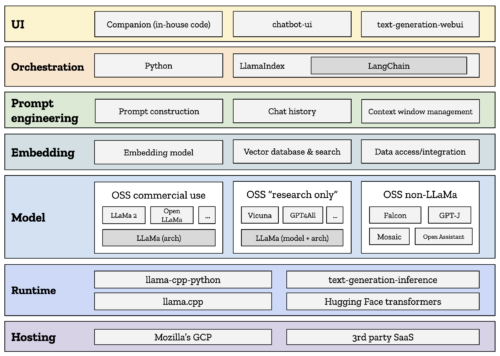
Artificial intelligence may well prove one of the most impactful and disruptive technologies to come along in years. We want to understand, support, and contribute to these efforts because we believe that they offer one of the best ways to help ensure that the AI systems that emerge are truly trustworthy. With this in mind, a small team within Mozilla’s…
14 Mar 2023
We want entrepreneurs and builders to join us in creating a future where AI is developed through this responsible lens. That’s why we are relaunching our Mozilla Builders program with the Responsible AI Challenge. The post Mozilla Launches Responsible AI Challenge appeared first on Mozilla Hacks - the Web developer blog.
7 Dec 2022
A product is first an idea, then a project, and then a prototype. Here, at Mozilla, our awesome community is there every step of the way to support and contribute to our products. None of what we do would be possible without this multicultural, multilingual community of like-minded people working together to be a better internet. The post How the…
27 Jun 2022
As part of our work to ensure a free and open web, we've been working together with Ecma International, and many partners to write a License inspired by the W3C Document and Software License. Our goal was that JavaScript’s status would align with other specifications of the Web. In addition, with this new license available to all TCs at Ecma…
23 Jun 2022

For the last year, we've been working on the development of rust-minidump, a pure-Rust replacement for the minidump-processing half of google-breakpad. The final part in this series takes you through fuzzing rust-minidump. The post Fuzzing rust-minidump for Embarrassment and Crashes – Part 2 appeared first on Mozilla Hacks - the Web developer blog.
16 Jun 2022
Samuel Aboagye is a genius. Aboagye is 17 years old. In those 17 years, he’s crafted more inventions than you have, probably. Among them: a solar-powered bike and a Bluetooth speaker, both using recycled materials. We caught up with Aboagye over video chat in hopes that he’d talk with us about his creations, and ultimately how he’s way cooler than…
28 Apr 2022

The latest Common Voice dataset, released today, has achieved a major milestone: More than 20,000 hours of open-source speech data that anyone, anywhere can use. The dataset has nearly doubled in the past year. Mozilla’s Common Voice seeks to change the language technology ecosystem by supporting communities to collect voice data for the creation of voice-enabled applications for their own…
24 Mar 2022
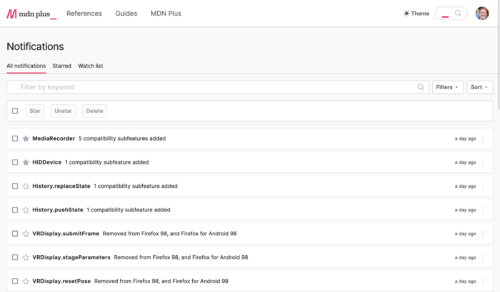
MDN is one of the most trusted resources for information about web standards, code samples, tools, and everything you need as a developer to create websites. Today, we are launching MDN Plus, our first step to providing a personalized and more powerful experience while continuing to invest in our always free and open webdocs. The post Introducing MDN Plus: Make…
30 Dec 2021

Sara Soueidan is an independent Web UI and design engineer, author, speaker, and trainer from Lebanon. Currently, she’s working on a new course, "Practical Accessibility," meant to teach devs and designers ways to make their products accessible. We chatted with Sara about front-end web development, the importance of design and her appreciation of birds. The post Hacks Decoded: Sara Soueidan,…
30 Nov 2021

Seyi Akiwowo’s reputation precedes her. Akiwowo is the founder of Glitch, an organization that seeks to end online abuse. We spoke with Seyi over video chat to learn about what drives her, why she does what she does and what she’d be doing if not battling trolls online for a living. The post Hacks Decoded: Seyi Akiwowo, Founder of Glitch…
6 Oct 2021
In a world where data and AI are reshaping society, people currently have no tangible way to put their data to work for the causes they believe in. To address this, we built the Rally platform, a first-of-its-kind tool that enables you to contribute your data to specific studies and exercise consent at a granular level. Mozilla Rally puts you…
5 Oct 2021
Starting with Firefox 93, Firefox will monitor available system memory and, should it ever become so critically low that a crash is imminent, Firefox will respond by unloading memory-heavy but not actively used tabs. This feature is currently enabled on Windows and will be deployed later for macOS and Linux as well. The post Tab Unloading in Firefox 93 appeared…
18 Aug 2021

Last month we removed a bunch of content from MDN. MDN is 16 years old (and yes it can drink in some countries), all that time ago it was a great place for all of Mozilla to document all of their things. As MDN evolved and the web reference became our core content, other areas became less relevant to the…
19 May 2021
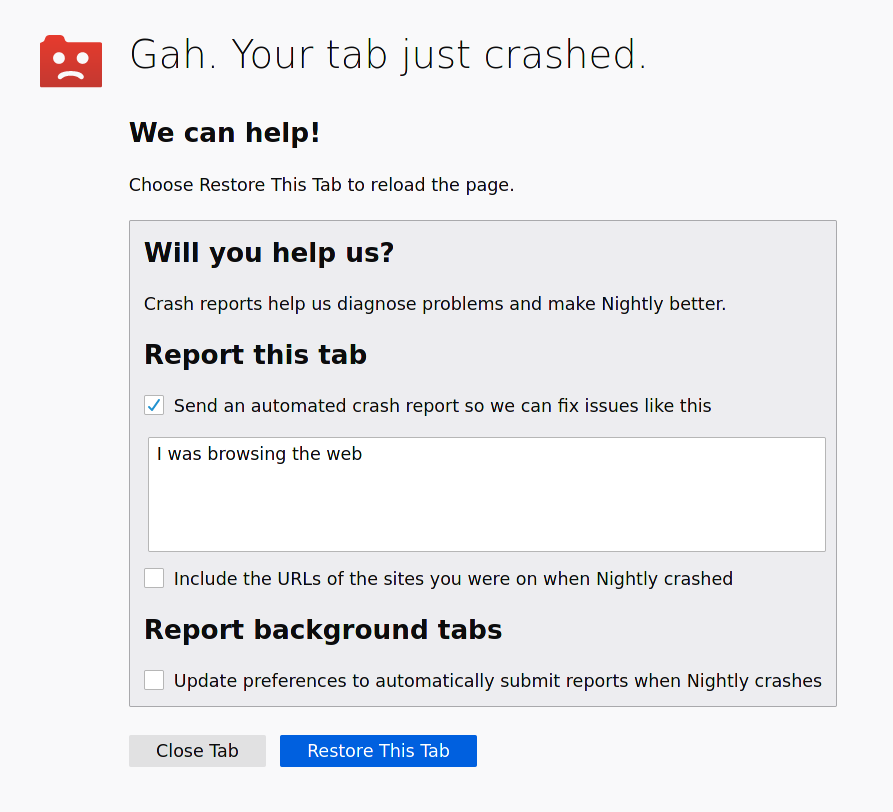
Roughly a year ago at Mozilla we started an effort to improve Firefox stability on Linux. This effort quickly became an example of good synergies between FOSS projects. The post Improving Firefox stability on Linux appeared first on Mozilla Hacks - the Web developer blog.
3 Dec 2020

After four years of incubation at Mozilla, we are excited to announce the release of WebThings Gateway 1.0 and a new home for the WebThings platform. This blog post will explain what to expect from the 1.0 release, the action you need to take if you want to transition your existing WebThings Gateway to new community-run infrastructure, and what to…
17 Nov 2020
This week the Servo project took a significant next step in bringing community-led transformative innovations to the web by announcing it will be hosted by the Linux Foundation. Mozilla is pleased to see Servo, which began as a research effort in 2012, open new doors that can lead it to ever broader benefits for users and the web. Working together,…
17 Dec 2019
Mozilla Hacks covered plenty of interesting territory in 2019. Our most popular posts introduced experiments and special projects, and described the evolution of groundbreaking platform technologies like WebAssembly and WASI. Mozilla WebThings continued to engage attention and adoption. And interest in Firefox releases and Firefox DevTools was stronger than ever. Read on. The post Mozilla Hacks’ 10 most-read posts of…
17 Apr 2019
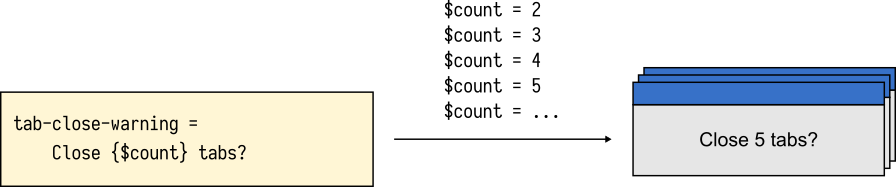
Fluent is a family of localization specifications, implementations and good practices developed by Mozilla. With Fluent, translators can create expressive translations that sound great in their language. Today we’re announcing version 1.0 of the Fluent file format specification. We’re inviting translation tool authors to try it out and provide feedback. The post Fluent 1.0: a localization system for natural-sounding translations…
17 Jun 2015
tl;dr I’m burying the lede with context and catch-up material first, so impatient or already-clued-in readers should skip to below the videos for today’s big news. Or just read Luke Wagner‘s blog post right now. My Fluent 2015 “ECMAScript Harmony: Rise of the Compilers” talk given on April 21st: Jeremy Ashkenas picked up this ball … Continue reading "From ASM.JS…
3 Apr 2014
Slides for the brief talk that I gave at a Harvard seminar on privacy and user data organized by John Taysom last week. My talk was really more about the “network problem” than the “protocol problem”. Networks breed first- and second-mover winners and others path-dependent powers, until the next disruption. Users or rather their data … Continue reading "The Next…
26 Mar 2014
I am deeply honored and humbled by the CEO role. I’m also grateful for the messages of support. At the same time, I know there are concerns about my commitment to fostering equality and welcome for LGBT individuals at Mozilla. I hope to lay those concerns to rest, first by making a set of commitments … Continue reading "Inclusiveness at…
24 Mar 2014
A quick note to update everyone on Mozilla news. Our Board of Directors has appointed me CEO of Mozilla, with immediate effect. I’m honored and humbled, and I promise to do everything I can to lead Mozilla to new heights in this role. I would first like to thank Jay Sullivan for his contributions to … Continue reading "Mozilla News"
12 Mar 2014
The World Wide Web is 25 years old today. The Web is a big deal (as is the Internet on which it is built), I don’t need to tell you! But I did have a few thoughts, solicited by a friend who asked “where [do] you think the future of the Internet will take us … Continue reading "The Web…
8 Mar 2014

Just over a week ago, I left Barcelona and Mobile World Congress 2014, where Mozilla had a huge third year with Firefox OS. We announced the $25 Firefox OS smartphone with Spreadtrum Communications, targeting retail channels in emerging markets, and attracting operator interest to boot. This is an upgrade for those channels at about the … Continue reading "MWC 2014,…
11 Jan 2014
Background It is becoming increasingly difficult to trust the privacy properties of software and services we rely on to use the Internet. Governments, companies, groups and individuals may be surveilling us without our knowledge. This is particularly troubling when such surveillance is done by governments under statutes that provide limited court oversight and almost no … Continue reading "Trust but…
31 Dec 2013
Sorry, I missed the chance to post a timely follow-up to Cisco’s H.264 Good News: as mentioned on the RTCWeb IETF mailing list, Cisco on the 9th of December released the OpenH264 codec on Github. Warning: code cleanup in progress (e.g., following RTP correctly in Gecko glue code), do not expect interoperable results in the … Continue reading "OpenH264 on…
18 Dec 2013
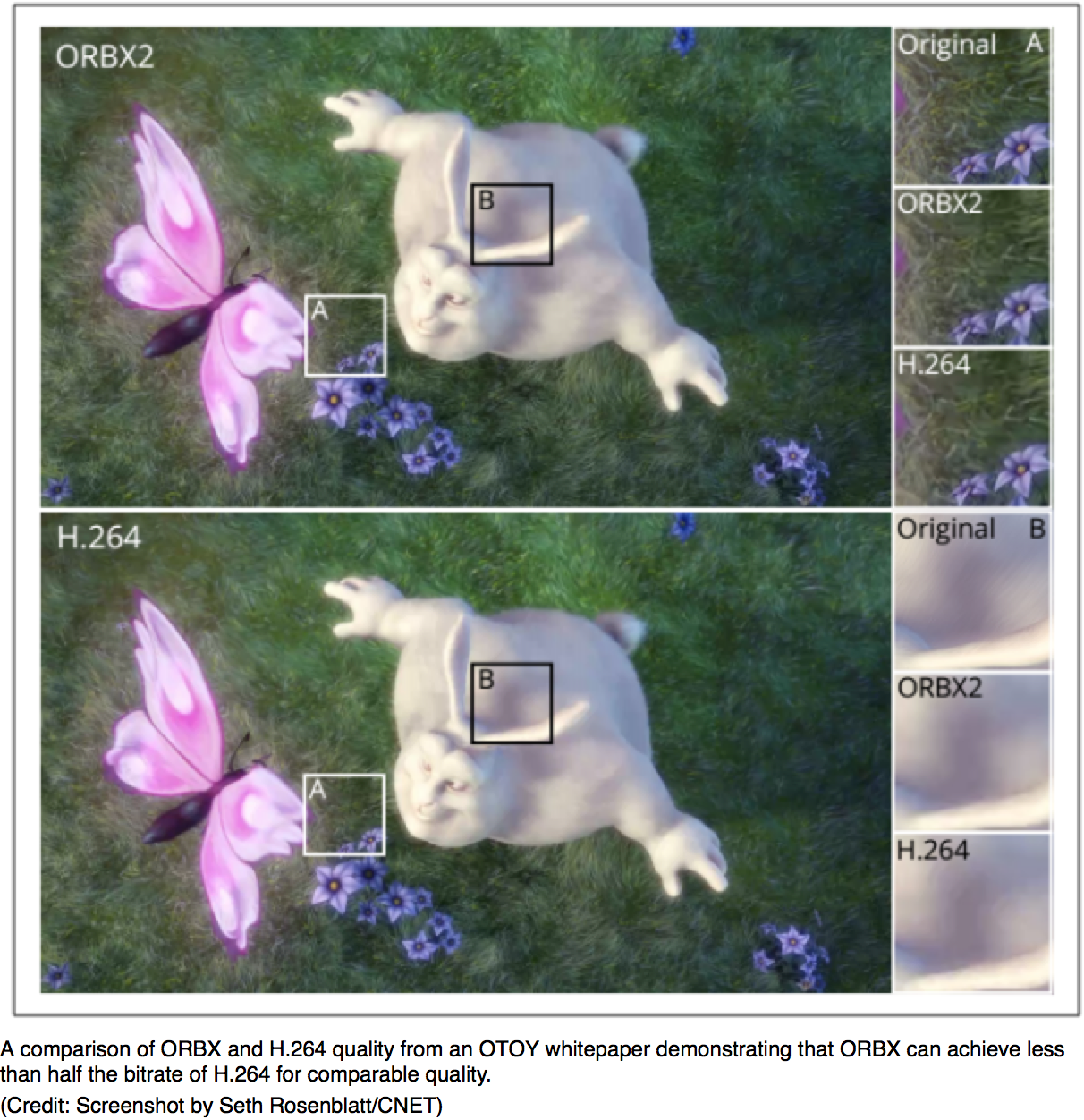
[UPDATE: see Jim’s fair comment below. /be] I’m pleased to report that OTOY today has announced good news about ORBX.js and the Amazon Web Services ORBX and OctaneCloud AMIs (Amazon Machine Instances, pronounced “AHmees” — who knew?), based on terrific adoption and developer interest: Free ORBX and OctaneCloud AMIs forever, not just for a trial … Continue reading "ORBX.js and…
6 Nov 2013
As noted at the Mozilla blog, OTOY and Amazon along with Autodesk and Mozilla have announced the next step in Amazon and OTOY’s GPU/cloud effort. Demo videos: This means developers can get started using ORBX.js with GPU-cloud encoding and downloadable decoding on all modern Web clients. It also means that any of the Hollywood Six … Continue reading "Today I…
30 Oct 2013
As I noted last year, one of the biggest challenges to open source software has been the patent status of video codecs. The most popular codec, H.264, is patent-encumbered and licensed by MPEG LA, under terms that prevent distributing it with open source products including Firefox. Cisco has announced today that they are going to … Continue reading "Cisco’s H.264…
23 Oct 2013

To lighten the mood: But actually, I’m serious. People are rightly concerned about what is going on in the W3C with DRM, as couched in the Encrypted Media Extensions (EME) proposal. Please read Henri Sivonen’s explanation of EME if you haven’t yet. As usual for us here at Mozilla, we want to start by addressing … Continue reading "The Bridge…
1 Jul 2013
Just under two years ago, we started Firefox OS as the Boot to Gecko (B2G) project, with little more than a belief that the Web should be the only platform you need to build an open mobile device ecosystem. This vision was so compelling that we found ourselves on a rocket, joined by developers and … Continue reading "Firefox OS…
19 Jun 2013
As you may recall from almost six weeks ago, we held the Safari-like third-party cookie patch, which blocks cookies set for domains you have not visited according to your browser’s cookie database, from progressing to Firefox Beta, because of two problems: False positives. For example, say you visit a site named foo.com, which embeds cookie-setting … Continue reading "The Cookie…
16 May 2013
Mozilla is engaged in a broad, deep conversation about Internet privacy. We believe in putting users in control of their online experience, and we want a healthy, thriving web ecosystem — we do not see a contradiction. However, sometimes a crucial experiment is required to prove it. To this end, we are testing a patch … Continue reading "C is…
4 May 2013
This morning, Mozilla and OTOY made an announcement: Mozilla and OTOY deliver the power of native PC applications to the Web, unveil next generation JavaScript video codec for movies and cloud gaming What this means: ORBX.js, a downloadable HD codec written in JS and WebGL. The advantages are many. On the good-for-the-open-web side: no encumbered-format … Continue reading "Today I…
4 Apr 2013

[air.mozilla.org video] [slideshare.net link] Disrupt any enterprise that requires new clothes. — Thoreau (abridged) adjusted for Mozilla by @lawnsea. I gave a brief talk last night at the Mozilla Research Party (first of a series), which happened to fall on the virtual (public, post-Easter-holiday) celebration of Mozilla’s 15th anniversary. I was a last minute … Continue reading "Mozilla at 15…
29 Mar 2013
This week, a number of Mozillians attended the annual Game Developers Conference in San Francisco to demonstrate how the Web is a competitive platform for gaming and game development. We’ve worked very hard over the past couple of months on technologies used to speed up the Web for game development, including asm.js, a JavaScript optimization … Continue reading "The Web…
7 Mar 2013

Last week started with a bang, with Mozilla’s Firefox OS launch at Mobile World Congress 2013. We announced that Firefox OS had won the support of 18 carriers, four device manufacturers, and a major chipset company (Qualcomm) at a barn-burner of a press conference in Barcelona on Sunday night. Pictures (the first shows the room … Continue reading "MWC 2013,…
15 Feb 2013
[This is an extended essay on the news out of Norway yesterday. See the closing for encouragement toward Opera and its fans, whatever the open source projects they choose to join, from me on behalf of Mozilla. /be] Founder Flashback I wrote about the founding of HTML5 in June, 2004, without dropping that acronym, mentioning … Continue reading "Why Mozilla…
17 Jan 2013
A short blog post to let everyone in the Mozilla community know the latest news. As the “About Brendan” sidebar says, I’m a founder of Mozilla, and since 2005 I have had the title of CTO. That job has entailed work on technical strategy, Web standards, influencing/partnering, Mozilla Research, public speaking, and talent-scouting. (Oh, and … Continue reading "Leading Mozilla:…
11 Jan 2013
Congratulations to Marcos Caceres, Yehuda Katz, Alex Russell, and Anne van Kesteren on the news of their election to the W3C Technical Architecture Group (TAG). This is great news: four out of the five reformers won. Back-story: in late 2010, TBL invited me to join the TAG. I declined with thanks for two reasons: I … Continue reading "TAG, You’re…
13 Oct 2012
This is a follow-up to Video, Mobile, and the Open Web. As promised there, OS-based H.264 support for the HTML5 <video> element has already landed in Gecko, and it just released this week in Firefox Beta for Android. Firefox OS (B2G to the early adopters!) also supports H.264 from the HTML5 <video> element. The challenge … Continue reading "HTML5 Video…
9 Oct 2012
This blog focuses on portions of the new-in-ES6 stuff I presented in my Strange Loop 2012 closing keynote, which was well-received (reveal.js-based HTML slides, some from my Fluent 2012 keynote, many of those originally from Dave Herman‘s Web Rebels 2012 talk [thanks!], can be viewed here; notes courtesy Jason Rudolph). UPDATE: the Strange Loop keynote … Continue reading "Harmony of…
19 Jun 2012
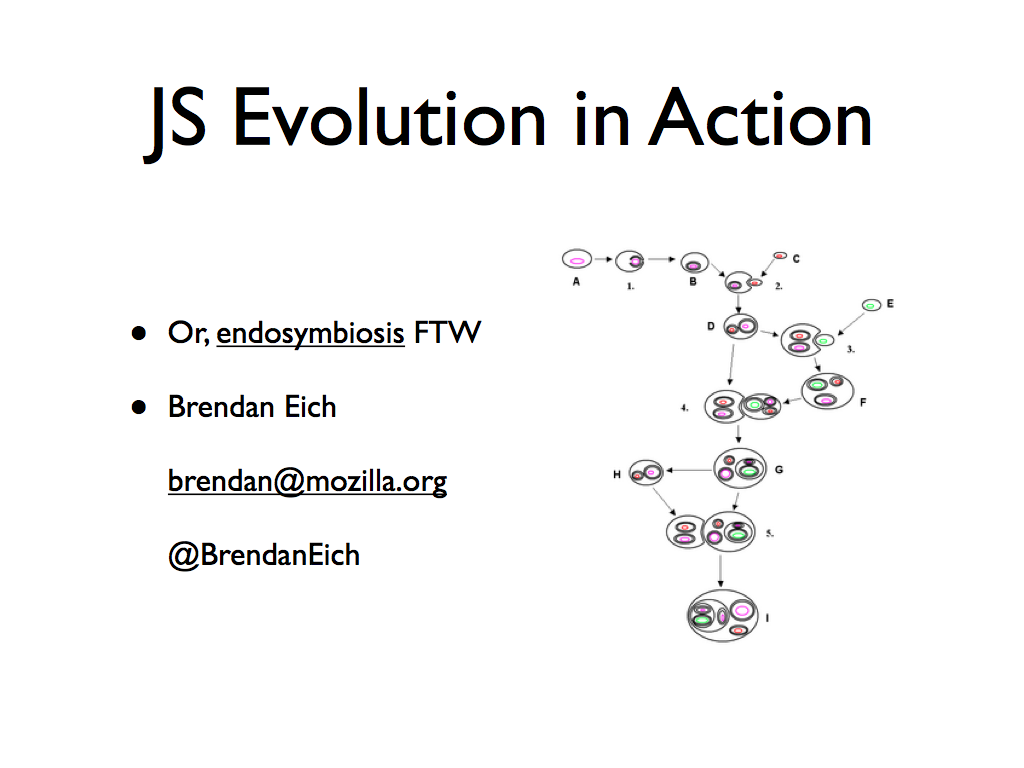
I gave two talks recently, first at O’Reilly Media’s go-big-with-JavaScript FluentConf, and then at my favorite regional JS conference, the delightful TXJS (gorgeous site design), curated and stage-managed by Alex Sexton, Rebecca Murphey, and other usual suspects. My Fluent video was up in record time, one achievement that the O’Reilly folks can brag about: There … Continue reading "Recent talks:…
15 Apr 2012
Most of the comments in this semicolons in JS exchange make me sad. The code in question: clearMenus() !isActive && $parent.toggleClass('open') relies on Automatic Semicolon Insertion (ASI) and so cannot be minified except by parsing fully (including ASI), observing the significance of the newline after clearMenus(), and inserting a semicolon when stripping that newline. Some … Continue reading "The infernal…
19 Mar 2012
[Also posted at hacks.mozilla.org.] I wrote The Open Web and Its Adversaries just over five years ago, based on the first SXSW Browser Wars panel (we just had our fifth, it was great — thanks to all who came). Some history The little slideshow I presented is in part quaint. WPF/E and Adobe Apollo, remember … Continue reading "Video, Mobile,…
27 Feb 2012
Mozilla is happy to support Facebook in forming a Core Mobile Web Platform W3C Community Group in which to curate prioritized, tiered lists of emerging and de facto standards that browsers should support in order for the Web to compete with native application stacks on mobile devices. The W3C Community Groups do not create normative … Continue reading "Community-Prioritized Web…
23 Feb 2012
Ragavan Srinivasan’s post about the forthcoming Mozilla Marketplace for Open Web Apps inspired me to write about Mozilla’s surging Web and Device API standards work. A bit of background. Mozilla has always contributed to web standards, going back to the start of the project. We co-founded the WHAT-WG to kick off HTML5. As readers of … Continue reading "Mobile Web…
29 Oct 2011

JSConf.eu 2011 was terrific, bigger and juicier than last year, with a strong sense of community felt from reject.js pre-conf: to start: to finish: Chris Williams makes a moving plea for an end to negativity, meaning trolling, flaming, mocking, and hating in online media. This sounds utopian, like “an end to history”. But it is … Continue reading "JSConf.eu"
24 Sept 2011
I took time away from the Mozilla all-hands last week to help out on-stage at the Intel Developer Forum with the introduction of RiverTrail, Intel’s technology demonstrator for Parallel JS — JavaScript utilizing multicore (CPU) and ultimately graphics (GPU) parallel processing power, without shared memory threads (which suck). Then over the weekend, I spoke at … Continue reading "CapitolJS, RiverTrail"
25 Aug 2011

TXJS 2011 A6 – Brendan Eich – Ecma TC39: The Good, The Bad, and The Ugly. [Main slides] [Paren-free] I spoke at TXJS, a really excellent regional JS conference, in June. Thanks to @SlexAxton, rmurphey, and everyone else involved. My talk was concerned with the good, bad, and ugly of Ecma TC39 (and I mean … Continue reading "My TXJS…
22 Jun 2011
As you may know, I wrote JavaScript in ten days. JS was born under the shadow of Java, and in spite of support by marca and Bill Joy, JS in 1995 was essentially a one-man show. I had a bit of help, even at the start, that I’d like to acknowledge again. Ken Smith, a … Continue reading "New JavaScript…
5 May 2011

NodeConf is a blast, and Mozilla had a 30 minute slot. Here’s the slideshare.net link. SpiderNode and V8Monkey are on github, of course. Paul O’Shannessy already blogged a few weeks ago. To avoid confusion, here’s the cheat-sheet: V8Monkey is SpiderMonkey with V8’s API around it. We are not done emulating the full V8 API. Because … Continue reading "Mozilla’s NodeConf…
@jashkenas was kind enough to let me join him for his JSConf.us session. Here is the slideshare link. I’ll comment on the individual slides below. Jeremy’s talk was entitled “CoffeeScript as a JS/next”, and I was interested in giving an update on Ecma TC39 Harmony progress, so when Jeremy and I met and caught up … Continue reading "My JSConf.US…
19 Jan 2011
Continuing in the vein of paren-free, I’d like to present a refreshed vision of JavaScript Harmony. This impressionist exercise is of course not canonical (not yet), but it’s not some random, creepy fanfic either. Something like this could actually happen, likelier and better if done with your help (more on how at the end). I’m … Continue reading "Harmony Of…
24 Nov 2010

The tl;dr version <Krusty>So, you kids want CoffeeScript, do you?</Krusty> <script type="harmony"> // placeholder MIME type if year > 2010 { syntax++ } for i in iter { // i is a fresh let binding! frob(i) } while lo <= hi { let mid = (lo + hi) / 2 // binary search blah blah … Continue reading "Paren-Free"
15 Nov 2010

After marinating for a few months, my JSConf.eu slides: Proxies are Awesome! (Mobile/No-Flash version) These are based directly on the excellent work of Mark Miller and Tom Van Cutsem, who developed the harmony:proxies proposal that is now approved for the next major iteration of the JavaScript standard (ECMA-262, probably edition 6 but we’ve learned the … Continue reading "Proxy Inception"
16 Oct 2010
jwz finally learns some JS and picks at an old scab that had almost healed. I reply in various comments. I include some little-known, kind-of-funny (not always ha-ha funny) history along the way to set several records straight. The issue before us now is whether to add value types to JS, perhaps by extending proxies, … Continue reading "Should JS…
13 Sept 2010
A Minute With Brendan is going great. I wanted to post a quick link to it for those of you who may have missed it. Good use of HTML5 <audio> too. Thanks to @Voodootikigod for producing it. The latest episode is about ES5 strict mode, stressing the importance of verifying that "use strict"; does what … Continue reading "A Minute…
24 Aug 2010

One of the best “researchy” investments we’ve made at Mozilla over the last few years has been in static analysis, both for C++ (including Taras Glek‘s excellent Dehydra, with which you write the custom analysis in JS) and now for JS itself: DoctorJS is based on Dimitris Vardoulakis‘s work this summer implementing CFA2 for JavaScript … Continue reading "Static Analysis…
21 Jul 2010
It’s good to be back. I let the old blog field lie fallow in order to focus on work in Ecma TC39 (JS standards), Firefox 3.5, 3.6 and 4; and recently on a new project that I’ll blog about soon. In the mean time [UPDATE and in case the embedded video fails], here’s the video … Continue reading "A Brief…
3 Sept 2008

We have been busy, mostly fixing bugs for stability, but also winning a bit more performance, since TraceMonkey landed on mozilla-central, from which Firefox 3.1 alpha-stage nightly builds are built. Tonight’s builds include a fix for the bug that ilooped a SunSpider test (my apologies to those of you who suffered that bug’s bite). But … Continue reading "TraceMonkey Update"
23 Aug 2008
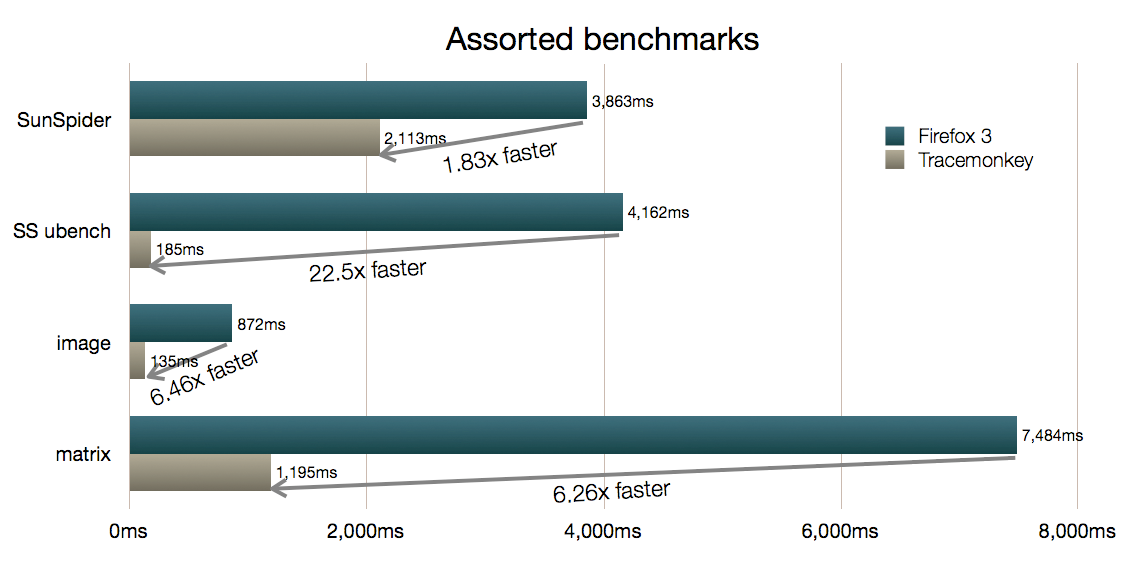
I’m extremely pleased to announce the launch of TraceMonkey, an evolution of Firefox’s SpiderMonkey JavaScript engine for Firefox 3.1 that uses a new kind of Just-In-Time (JIT) compiler to boost JS performance by an order of magnitude or more. Results Let’s cut straight to the charts. Here are the popular SunSpider macro- and micro-benchmarks average … Continue reading "TraceMonkey: JavaScript…
4 Apr 2008
It seems (according to one guru, but coming from this source, it’s a left-handed compliment) that JavaScript is finally popular. To me, a nerd from a tender age, this is something between a curse and a joke. (See if you are in my camp: isn’t the green chick hotter?) Brendan Eich convinced his pointy-haired boss … Continue reading "Popularity"
29 Nov 2007
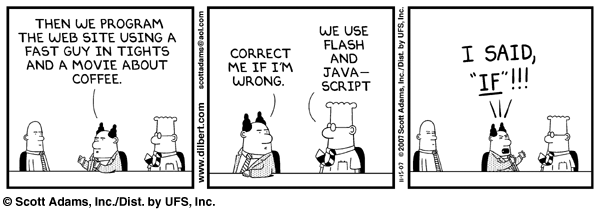
JavaScript 2 and the Open Web Brendan Eich Mozilla Corporation @media Ajax London 20 Nov 2007 Herewith a hacked-up version of my S5 slides, with notes and commentary interpolated at the bottom of each slide. Dilbert – the Big Time See how JS is paired with Flash — poor, mundane HTML, CSS, DOM! HTML5 needs … Continue reading "My @media…
6 Nov 2007
ES4 News Some news on language size: the proposed ECMAScript 4th edition (ES4) grammar is a bit more than twice as big as ES3’s, counting several ways (concrete productions, abstract syntax tree node types): Syntax ES3 ES4 ------ --- --- Concrete 238 490 Type Exprs 50 Classes & Interfaces 23 Patterns 17 Abstract 33 77 This … Continue reading "ES4…
1 Nov 2007
Chris, You seem to be repeating falsehoods in blogs since the Proposed ECMAScript 4th Edition Language Overview was published, claiming dissenters including Microsoft were ignored by me, or “shouted down” by the majority, in the ECMAScript standardization group. Assuming you didn’t know better, and someone was misinforming you, you (along with everyone reading this letter) … Continue reading "Open letter…
22 Aug 2007
From the inimitable Chris Double of Mozilla’s New Zealand brain trust: moving, rotating, scaling <video> in SVG (so who needs yet another non-standard plugin?). If you make a build from Chris’s code, don’t forget to view-source the demo. /be
26 Jul 2007
My Ajax Experience West keynote covers a lot of ground, with slant-wise truth telling the over-arching theme. Mozilla believes in fairly radical open source action, including open strategy. In that spirit, three new projects, the first already known via jresig: ActionMonkey, the project to join forces between SpiderMonkey and Tamarin, being driven by Jason Orendorff … Continue reading "New Projects"
9 Jun 2007
As Dave Herman just posted at Lambda-the-Ultimate, we ECMA members who have been working on the successor to the JavaScript standard have a new www.ecmascript-lang.org website, which now hosts the “milestone 0” release of the ES4 Reference Implementation, written in Standard ML of New Jersey. As Dave notes, this is a “pre-release” in the Open … Continue reading "ECMAScript Edition…
26 Apr 2007
Adobe open-sources Flex under the MPL — a good second step. Congratulations to all the people who made it happen. My browser-war battle-heightened senses tell me you’ll see more open-sourcing, and no small amount of “openness” hype, from several big players in the coming days. As we mozilla.organs learned the hard way, getting the license … Continue reading "Open Source…
13 Mar 2007
A small presentation I gave at SXSW asks what it means to be “Open” in the sense of open standards, open source, and a web whose major content formats are not controlled by a single vendor (I credited Nat Friedman’s amusing keynote from last year’s Free Software & Open Source Symposium for inspiration of the … Continue reading "The Open…
12 Feb 2007
This is not an original thought, but I write with some authority here. I hacked Unix kernel code out of grad school at SGI, in SGI’s “good old days” (1985-1992). Among other things, we took single-threaded (ST) kernel code and multi-threaded (MT) it on SGI’s SMP boxes. I won a free trip to New Zealand … Continue reading "Threads suck"
10 Nov 2006
For Mozilla 2, I proposed that we use Oink, or really Elsa, to build a tool that can help automate deCOMtamination, switching to C++ exceptions instead of nsresults, and similar tasks beyond the reach of sed or perl. The idea is to specify pattern and replacement abstract syntax trees (ASTs), and have the tool match … Continue reading "Oink-based Patch…
7 Nov 2006
I just committed the initial revision of mozilla/js/tamarin, the open-source ActionScript Virtual Machine contributed by Adobe. But I had nothing to do with this fine work. It’s the product of some talented folks at Adobe (originally at Macromedia; at least one of whom has moved on and is doing a startup). Tamarin, the open-source AVM, … Continue reading "Project Tamarin"
14 Oct 2006
Mozilla has gone from open source whipping boy in 1999 to open source poster child since 2004, due in large part to the success of Firefox. For that we can thank some amount of luck with our “timing the market” — the browser market that no one knew existed, until it was suddenly clear in … Continue reading "Mozilla 2"
22 May 2006
The talk I gave last Friday at XTech 2006 in Amsterdam, a revised and extended version of the talk I gave at the Ajax Experience the previous week in San Francisco, is here.
28 Apr 2006
Graydon has been busy. The XPCOM garbage cycle collector lives. Huzzah! One (half-way) down, two to go…. /be
19 Feb 2006
Mark Hammond’s work to support Python in XUL is nearly done. The DOM_AGNOSTIC2_BRANCH should land in the next few weeks. Already I see many on the PyXPCOM list testing Mark’s fine work, chomping at the bit to use Python in XULRunner. This brings to mind a hot topic in my recent hacking: infusing JS with … Continue reading "Python and…
9 Feb 2006
Everyone who gets far enough into Mozilla code has that “wow, this is chatty . . . verbose . . . inefficient even” reaction to XPCOM — or so I thought. Having played Cassandra once in the dark days before Netscape 6, lived to witness deCOMtamination, and watched the next generation of core hackers grow … Continue reading "Fresh XPCOM…
21 Dec 2005

I was on another Gillmor Gang — always enjoyable. The current Firefox 2 / Mozilla 1.8 branch + Firefox 3 / Mozilla 1.9 trunk plan is here, complete with branching diagram artwork from Asa: /be
10 Nov 2005
Goals Here are some design notes for JS2, starting with my goals, shared in large part by ECMA TG1 for ECMA-262 Edition 4: Support programming in the large with stronger types and naming. Enable bootstrapping, self-hosting, and reflection. Backward compatibility apart from a few simplifying changes. (Goal 2 implies many things beyond what is discussed … Continue reading "JS2 Design…
4 Nov 2005
Mozilla is a huge project, now cursed with success. It did not start that way. To think about where to go, we should mull over how we got here. Over the years since the first major roadmap, I’ve tried to steer the project toward the shortest path to the next port of call that was … Continue reading "New Roadmaps"
27 Oct 2005
Recap Too much travel and conference fun, too little blogging: I was invited to present a keynote at ACM ICFP 2005 in Tallinn, Estonia at the end of September. The very kind program comittee was unanimously interested in me as the ‘where the rubber meets the road’ speaker. I hope I delivered; I still have … Continue reading "Recap and…
9 Sept 2005
I announced XUL support for Python at ETech to cheers, and now Mark Hammond has begun delivering the goods. See the DOM_AGNOSTIC_BRANCH for his work to enable Python (and other languages, but Python for sure, and other languages need their own champions to do some work) to be used when writing trusted XUL applications and … Continue reading "Python for…
4 Aug 2005
Just a quick pointer to my slashdot post on the Mozilla Corporation story. At least dria found it clear and to the point about why we did what we did. Back next week with some JavaScript news. /be
13 Jun 2005
With DHTML and AJAX hot (or hot again; we’ve been here before, and I don’t like either acronym), I am asked frequently these days about JavaScript, past and future. In spite of the fact that JS was misnamed (I will call it JS in the rest of this entry), standardized prematurely, then ignored and stagnated … Continue reading "JavaScript 1,…
1 Jun 2005

This roadmap update has been much-delayed, as we have juggled priorities and sweated security releases on the AVIARY_1_0_1 branch. Sorry for the delay; I will keep the roadmap up to date much more frequently from now on. The new roadmap restarts the document with as little repeating boilerplate as possible. Highlights: The main point is … Continue reading "New roadmap…
31 May 2005
Mozilla had a strong presence at XTech last week. To my mind the high point was the awesome spinning-SVG-containing-HTML demo that roc gave. This happens to resemble an early Avalon demo (I can’t find a link to it, but I believe there was a video on the web some time after the 2003 Microsoft PDC), … Continue reading "XTech"
25 Jan 2005
The good news is that our nominal error rates are respectable at first glance: as good as or better than than other large open source projects.
20 Nov 2004
Back in my February 2004 Developer Day slides, I promoted the idea of using Eclipse to create a XUL application builder, with direct-manipulation graphical layout construction and editing, project management wizards, etc. Although a few people expressed interest and even did some hacking (the MozCreator project being the most conspicuous example, although not Eclipse-based), no … Continue reading "OpenLaszlo and…
9 Nov 2004
The Greek poet Archilochus wrote “The fox knows many things, but the hedgehog knows one big thing.” But what does the Firefox know? Both many things (tabbed browsing live bookmarks popup blocking mouse gestures extension architecture download manager small fast . . .) and one immense thing: that the power of the Internet and the … Continue reading "The Firefox…
10 Sept 2004
For the impending PR1 candidate builds (tomorrow’s, we hope): Alternate Style Sheet switcher makes a come-back thanks to Fantasai, with Ben reviewing and Asa approving. The statusbar icon won’t show up unless the page has alternate sheets, which is an improvement. There’s a View menu item to disables all author-level style sheets. Work Offline is … Continue reading "Firefox news…
25 Aug 2004
A lot of folks in the Mozilla community share the reaction Boris had to some deeply mistaken, tentative and now-aborted plans to remove View / Source and other “developer” features from Firefox. I wanted to point out that these plans were not made with agreement from me or, as far as I can tell, from … Continue reading "Everyone remain…
11 Aug 2004
The slides that shaver and I presented at last Friday’s Mozilla Developer Day are up now. As presented at dev-day, these slides nicely demonstrated support for Apple’s canvas tag, embedded in Mozilla as <xul:canvas> and implemented using Cairo (a static PNG of the clock and animated stars must stand in for now, in the published … Continue reading "Mozilla Developer…
12 Jul 2004
Dave Winer seems to have misheard my exchange with the Gillmor Gang about RSS and HTML: I was asked, at around 36 minutes into the show (not 20 minutes), whether the Web Hypertext Application Technology Working Group considered RSS to be “completely orthogonal” to HTML, and I said (paraphrasing slightly) “RSS is not on the … Continue reading "WHATWG and…
15 Jun 2004
Multiple languages supported, including JS, Java, and Python. Good cross-language integration: inheritance, type matching, etc. Cross-language debugging, ideally including C++. One GC to rule them all, preferably one shared GC, not a super-GC ruling a zoo of heterogenous GCs and reference-counting subsystems. Decent JITed performance, because performance matters when you can least afford to rewrite … Continue reading "Mozilla 2.0…
12 Jun 2004
libxul.so/libxul.dll, a versioned shared library with minimal, frozen, documented API exports, and fast intra-library calling convention code (so small footprint compared to today’s “GRE” or “XRE”). xulrunner/xulrunner.exe, so you can write ‘#! /usr/bin/xulrunner’ at the top of a .xul file and get busy. XUL 2 and XBL 2 — standardized specifications, greater binding language power, … Continue reading "Mozilla 2.0…
5 Jun 2004
I spent a day at the recent w3c workshop on web apps and compound documents. Due to vacation, that day was the second, so I missed the chance to hear JavaScript praised as the worst invention of all time. The adolescent sniping and general irrelevance continued on the second day, however. The sad fact is … Continue reading "The non-world…
29 Apr 2004
Miguel nails the key threats in XAML/Avalon/whatever: fancy graphics, widgets, and layout; easier XML-based authoring; better “managed code” model for when you have to hack; and a web-like deployment model with sandboxing for security. The deployment model is a huge advantage over conventional app development. Web browsers and FlashPlayer have benefited from it, even as … Continue reading "Action and…
I ran across an old posting from dbaron about how CSS’s 2nd generation still can’t do simple box layout needed for UI, which means that the web is full of hacky table tags. XUL box layout, which appears to be headed for standardization in the CSS working group, is a known solution that should be … Continue reading "XUL box…
I’ve been posting to slashdot a bit in the Mozilla Foundation Meets The GNOME Foundation piece. Not entirely a waste of time, and more interactive than blogging — I like the “meeting of minds in public” part more than the tub-thumping.